
Your customers are frustrated every time they struggle to find parking. What if you could solve this problem with a simple app that helps them find a spot easily? A parking app may contribute to enhancing customer experience by bringing value to the business.
If you are thinking of creating a parking app for your business, chances are you’re looking to find out how much it is going to cost. Well, the cost to build a parking app depends on a lot of factors like features wanted, platform (iOS or Android) required, type, and its complexity.
In this blog, we break down factors that affect the cost of developing a parking app. This will guide your budget and prepare you for the process of developing such an application. Let’s dive into it!
What is a Parking App?
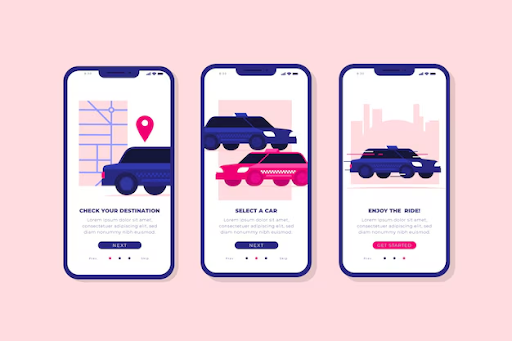
It is an application on your mobile phone that helps you find, reserve, and pay for parking. The applications provide real-time information on free parking spaces and help navigate through these areas with GPS.
Further, the user can pre-book a space, make online payments, and share parking space with another person. The application is particularly helpful in densely populated urban cities or other high-end places like shopping malls, offices, or event locations.
Parking App Market Statistics
Before we discuss the cost of building a parking app, it’s crucial to understand why you should create such apps.
-
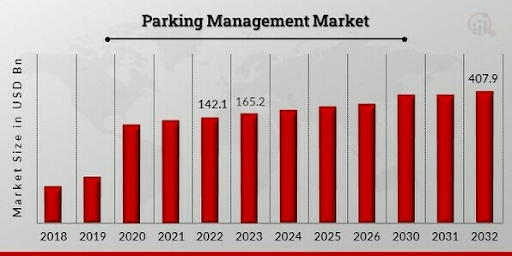
Parking Management Market Growth
This is expected to rise from an estimated $165.2 billion in 2023 to $407.9 billion by 2032, at a promising CAGR of 16.26%. This upward trend essentially signals a shift toward more digitized solutions when it comes to parking.
-
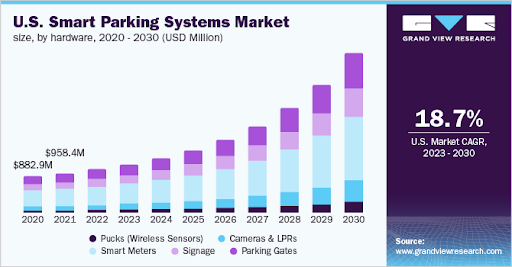
Smart Parking System Market (USA)
The market for U.S. smart parking systems is expected to grow at a CAGR of 18.7% from 2023 to 2030. Smart parking systems use technologies such as sensors, real-time data, and mobile apps to help drivers find available parking spaces, thereby saving time and reducing congestion in crowded areas.
-
Global Smart Parking Market
The global smart parking market size will reach $4.1 billion by 2027, growing at a CAGR of 18.2%. This growth is on account of the technological progressions that have been experienced, such as IoT-enabled sensors and cloud-based systems. This makes finding available parking easier and more efficient, especially in urban regions where parking spaces are a constraint.
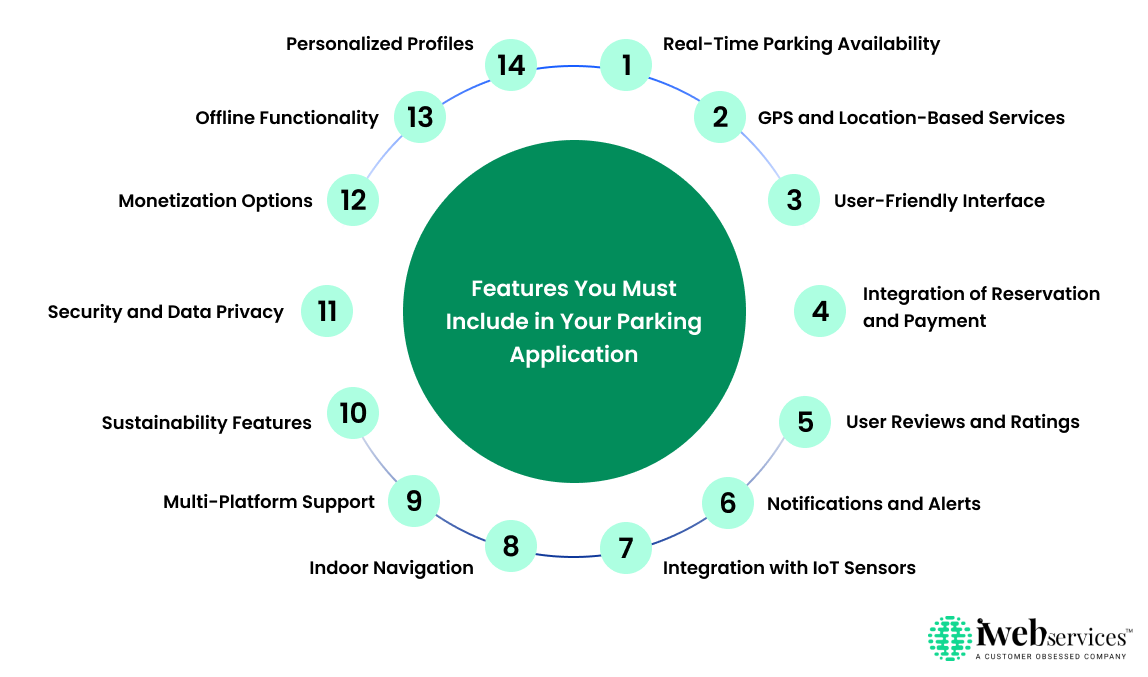
Features You Must Include in Your Parking Application
No doubt, you need to hire mobile app developers in India who are trusted and skillful. However, there are some key features that you must consider before hiring any team. This way, you can plan your app in advance and share your requirements properly:
1. Real-Time Parking Availability
In addition, this feature shows information regarding the parking availability in a particular place in real-time. It enables people to find parking places quite easily without taking much time to search for parking. Powered by data from parking sensors, camera systems, or GPS data from other users. Therefore, it is reliable and timely. Time is obviously saved here, and surely frustration isn’t incurred as much.
2. GPS and Location-Based Services
This feature will enable the app to ascertain the user’s precise location and give the nearest parking spaces available. This is an important feature for busy urban areas where parking space is scarce. It helps in finding the closest parking spot. The app will provide turn-by-turn directions so that users are not confused.
3. User-Friendly Interface
The interface should be user-friendly so that a user is able to easily search, book, and pay for parking without getting confused. The design should be intuitive, simple, and visually engaging. Clear navigation, prominent call-to-action buttons, and easy-to-read text make the app accessible to all age groups.
4. Integration of Reservation and Payment
This service allows the user to book a parking space in advance to avoid uncertainty during peak seasons. Forms of payment, like credit or debit cards or other electronic ones such as a mobile payment system and an e-wallet, come with acceptance so that users have an easy experience. It helps minimize or eliminate cash, as well as on-site methods of payment, for convenience and security.
5. User Reviews and Ratings
This allows for transparency by allowing users to review and rate specific spaces. It directs newly incoming users to make the right decisions by choosing the spaces based on quality, convenience, and cost. Ratings also serve as a motivating factor to improve the performance of owners in keeping or enhancing services.
6. Notifications and Alerts
Push notifications always keep users updated on what is going on regarding their parking. This can include confirmation of a booking, time-left reminders for the parking spot, special offers on available discounts, and other changes related to the status of the parking.
Notifications improve user experience through adequate, timely information that allows the user’s advance planning.
7. Integration with IoT Sensors
IoT sensors in the parking system will provide users with live data on parking spot availability. These sensors detect the vehicle and send back the information to the app, which then updates the users with correct, real-time parking data. It reduces the guessing game that users usually engage in and finds them an available spot much more efficiently.
Also Read: Cost to Build a Crypto Trading App
8. Indoor Navigation
Large structures such as shopping malls, airports, or hospitals are greatly benefitted in terms of indoor navigation. It ensures that users reach a specific floor or part within the garage and locate their parked car or an available parking spot. This avoids confusion in large and complex parking structures, thereby improving the user experience.
9. Multi-Platform Support
To reach a wider target, the parking app must be available on both iOS and Android. This would allow users with different types of devices to make use of it as well. Cross-platform applications can have native apps or hybrid development frameworks, making the experience for users seamless, regardless of their device.
10. Sustainability Features
In response to environmental concerns, parking apps increasingly include features related to sustainability. These include options to find electric vehicle (E.V.) charging stations, information on public transportation options, or even suggestions for shared rides to reduce individual car use. This helps users find more eco-friendly choices and promotes a more sustainable way of commuting.
11. Security and Data Privacy
As parking applications deal with location data, payment details, and personal information, ensuring data privacy and security are of prime importance. A good application must include robust security measures such as encryption, secure gateways for payment, and adherence to laws like GDPR or other applicable privacy laws. This will protect the users’ information, and people will be assured of using the application.
12. Monetization Options
A parking app is monetized through revenues like advertising, a booking transaction fee, subscription plans, or even a partnership with a parking facility. The monetization strategy will depend on the target audience, business goals, and location. It gives developers an opportunity to be profitable while still adding value for their users.
13. Offline Functionality
In areas that have less mobile signal connection, such as underground parking spots or outlying locations, many users would still prefer the ease of being offered a quick and convenient reminder of a saved parking space or an easy display of previously viewed maps to previously reserved rooms. Through this method, the connectivity would still not affect usability.
14. Personalized Profiles
Personalized profiles will be able to save favorite parking spots, payment preferences, and vehicle information, thus saving time for a user when trying to park. This reduces and facilitates the parking process, which becomes faster and more efficient. Also, personalized recommendations will complement preferences and past behavior from a user’s side, hence enhancing the whole application experience and adding value to their needs.
Different Types of Parking Applications
Here are some different types of parking apps and the cost to build such apps:
1. Local Parking Application
Cost: Range from $15,000
The local parking application is those apps that have geographical localization, such as a parking application for a neighborhood, shopping center, or office complex. They assist people in locating available parking space in an area often in highly congested urban environments. It is suitable for small project sizes and is the cheapest way to test a market before scaling up.
2. Global Parking Solutions
Cost: Range from $35,000
It serves those who require parking across different cities or even states. Most of these services are big parking spaces either on the streets or within the garages and contain features like booking in advance and also having the opportunity to pay.
It perfectly suits any traveler moving between towns to make repeated travels as they also have to park and stay each time.
3. Sharing Parking App
Cost: starting at 20,000$
Sharing parking applications allows users to either lease or share their parking slots with other people. These usually target business complexes, home areas, or hospitality sectors like hotels and restaurants. Users, who require such flexible spaces for parking over short hours or months depending on their needs, seek such applications.
4. Parking Time App
Cost: As from $45,000
This type of application allows users to reserve parking space for a certain period, either in hours or a day, in some locations. It is a combination of local and global parking applications which targets users who require parking for only short periods or for specific needs. The ideal users of Parking Time Apps are commuters, tourists, or people attending some event and requiring temporary parking arrangements.
Explore More: How Much Does it Cost to Build an On-Demand Service App?
Factors Decide the Cost to Build a Parking App
There are several factors deciding the cost of your app; here are the major ones:
1. Project Complexity
The more complex the project, the more it would cost to develop. This application would be less costly on the simpler app side as it would feature searching and integration into maps; conversely, the more complex one would have functionalities like AI-powered parking predictions, the integration of IoT sensors, and indoor navigation.
2. Location of Development Company
The geographical location of the development team costs a lot. For example, the cost of U.S.-based developers would be $100 an hour. The same could only be charged in India at a whopping $25 per hour. It could be based on a difference in the cost of labor, but factoring out all this, cost and quality have to determine what one to go for.
3. App Platform
This, again, will depend on the platform where you are interested in creating your parking application. A development on iOS costs more than an application development for Android. Apple App Store is highly rigid on terms and policies that require their approval. It will cost an organization relatively less when both Android and iOS applications are aimed at as it extends development time and may be cost-effective in the shortest time.
4. Third Party Integration
This is another factor that affects the cost of building a parking app. For example, payment systems such as PayPal and Stripe or APIs for the acquisition of real-time parking data add complexity to the development of an application. Each of those would add a bit of code, testing, and maintenance, increasing the development cost of an application. Depending on how many integrations are required for a certain application, the developing application cost might jump too high.
5. Team Size
It is determined by the size of the development team because a large team contains developers, designers, and QA testers that will always incur a total cost. On the other hand, smaller applications may not necessarily require more developers, though bigger ones with more features require bigger teams. At times, your cost will be determined by the experience and level of expertise your team has.
Cost Breakdown of a Parking App Development
This table depicts the cost breakdown of a parking mobile app development based on different factors:
| Development Stage | Percentage of Total Cost |
| Consultation | 5% |
| UI/UX Design | 10% |
| Development | 50% |
| Testing | 15% |
| Deployment | 10% |
| Post-Deployment | 10% |
The development stage is the cost chunk, as they are the actual main feature of the application. Testing holds a major percentage of the cost component (15%) to ensure that the user interface does not have bugs. Consultation and deployment stages, though lesser percentages, would not be nil in building a successful application.
Some Popular Parking Apps
Let’s see some famous parking apps you can take inspiration from:
1. Parkopedia
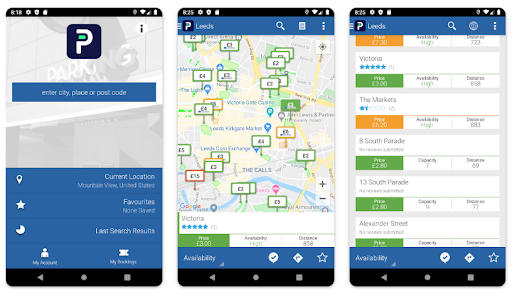
Known as the “Wikipedia of parking,” Parkopedia is a gigantic database offering more than 70 million parking spaces information spread across more than 15,000 cities in the world. Users can see in real time what’s available, how much it costs, and what’s forbidden in order to make better choices while choosing parking when traveling.
2. Honk
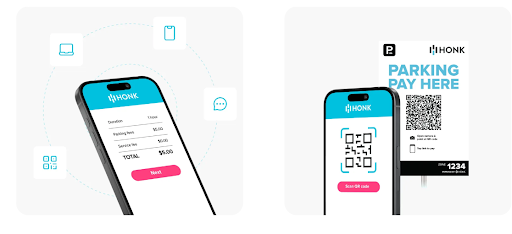
Honk will allow users to book a parking reservation in advance, particularly in highly congested areas and in crowded events. One can easily find it in the big cities because its usage allows drivers to reserve a secure parking spot with little stress and without the uncertainty of available space.
3. SpotAngels
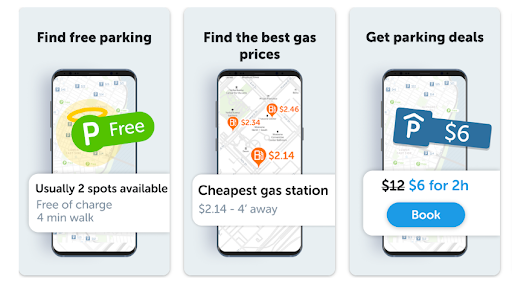
SpotAngels is an application that lets users find street parking in cities across the U.S. and Europe. It shows live information about real-time availability and parking restrictions. It helps drivers avoid getting parking tickets. Its interface is user-friendly, easy to spot free parking or discounted options.
4. ParkSpot
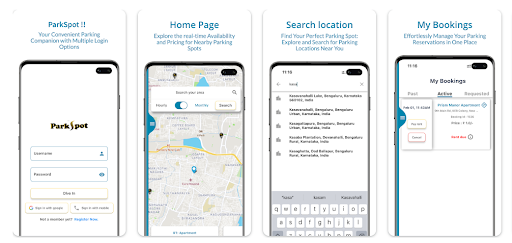
Another popular app is ParkSpot, which allows drivers to find convenient parking spots in crowded urban areas. The app focuses on quick access to secure parking, with features such as real-time updates and advance booking options.
So, are you planning to build your own parking app? iWebServices can help you out.
Learn More: What is the Cost of Developing an App in India
Why Choose iWebServices?
Our team of mobile application developers at iWebServices creates cutting-edge, creative solutions for Android and iOS applications for our clients worldwide. We have successfully developed more than 100+ mobile applications for various industries.
At iWebServices, we leverage deep industry knowledge and experience in advanced technologies like AI, ML, and blockchain to provide custom-made app solutions that fit the needs of your business perfectly. Here’s why we are your perfect app development partner:
- Exceptional App Development Services
- Proven Industry Expertise
- Creative & Innovative App Solutions
- Transparent Pricing without any Hidden Costs
- Unmatched Technical Expertise
- Agile Development Process
- Flexible Engagement Models
- Cost-effective Post-Deployment Support
Conclusion
The demand for car parking apps is rising. So, the future prospects are promising as well. In 2025, it’s a profitable decision if you think about developing an on-demand parking spot finder app.
We hope the cost to build a parking app is now clear to you. If you want to hire the best mobile app development company in India, iWebServices is a one-stop destination for you. We are proud of our talented team of mobile app developers and creative UX/UI designers that ensures the flawless development of all Android and iOS mobile applications. Why wait? Let’s get started!
FAQs
Q1. How long does it take to develop a parking app?
The development time depends on how complex the features would be. A simple parking app would take about 2-3 months. Advanced, richer features could take up to 4-6 months or more.
Q2. How do I monetize my parking app?
You can monetize the parking app in a variety of ways, including collection of transaction fees on reservations, subscription plans, advertising, partnerships with parking facilities, or even premium features like advanced booking and access to real-time data.
Q3. What technologies are required to build a parking application?
The core technologies for a parking app include GPS and location-based services, real-time data update that often depends on IoT sensors, payment gateway integrations, cloud storage, and push notifications. Advanced applications may also make use of machine learning as predictive analytics or AI for enhanced user experience.

Arpana K
Arpana is an integral member of the iWebServices team, bringing her expertise and dedication to our content marketing and insights efforts. With a talent for creating engaging and informative content, Arpana plays a vital role in ensuring our messaging resonates with our audience. Her keen understanding of market trends and her ability to translate data into actionable strategies make her a valuable asset to our team. Arpana’s contributions to our blog are filled with insightful perspectives and practical advice, helping our readers navigate the dynamic landscape of digital marketing.