
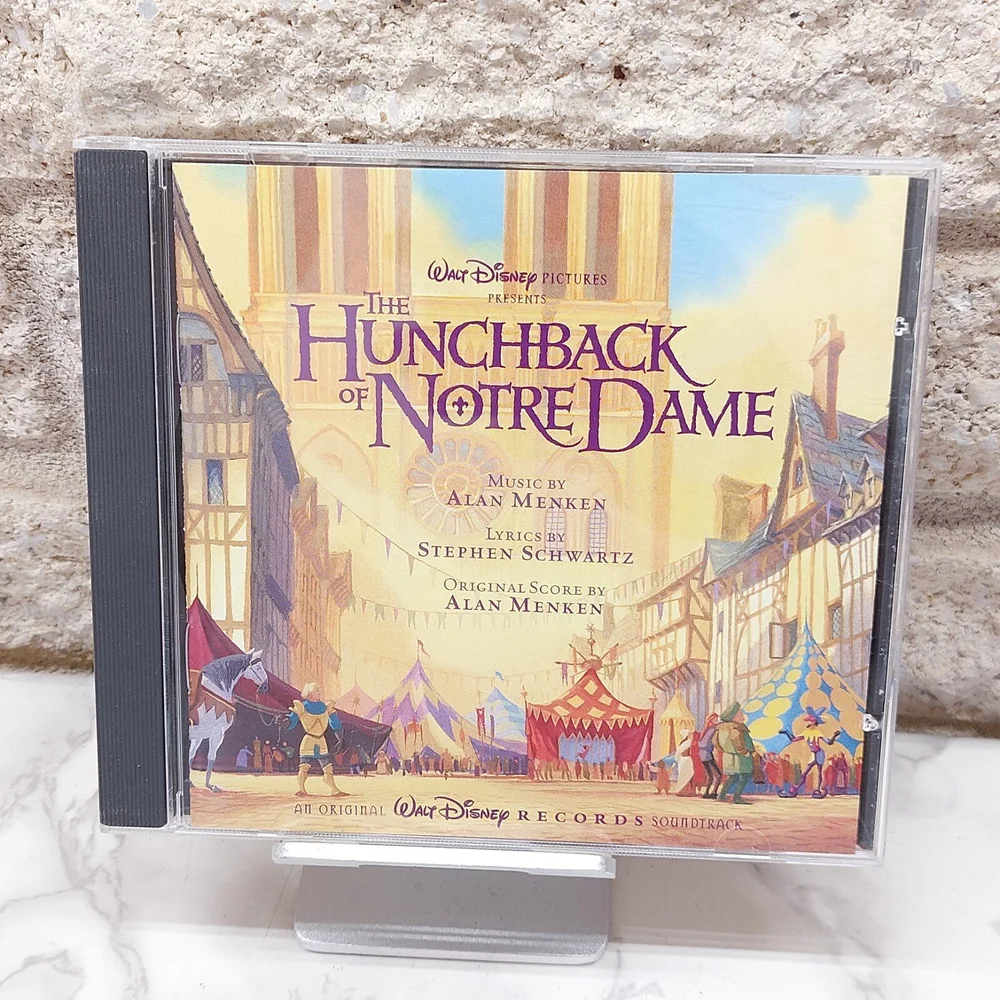
by Chris Peterson
It is still kind of unbelievable that The Hunchback of Notre Dame exists as a Disney animated film at all.
This is a movie built around lust, sin, hypocrisy, repression, cruelty, and public humiliation, all pulled from one of the darkest stories Disney ever chose to adapt. Even now, revisiting it as an adult, I keep coming back to the same thought: how did this get made under the Disney banner?
I am going to get into that much more as this series goes on, because it is a huge part of what makes the film so fascinating.
But even before all of that, I want to say this plainly: I think The Hunchback of Notre Dame is one of the best animated movie musicals ever made.
And more than that, I think this may be Stephen Schwartz’s best lyric work.
That is not a small statement, but there is something about what he and Alan Menken accomplish here that feels almost impossible. The score is grand, emotional, spiritual, and unsettling when it needs to be, but it never loses the humanity at its center.
That is why this soundtrack has stayed with me the way it has. It does not just decorate the story. It wrestles with it.
Alright, let’s get into it, track by track.
“The Bells of Notre Dame”
This is one of the greatest openings in any Disney film, and I do not think that is a hot take.
The storytelling is so efficient that by the time it ends, you already understand the emotional and moral shape of the movie. You know who Quasimodo is. You know who Frollo is. You know the church matters. You know guilt matters. You know image and truth are not going to be the same thing here.
And Broadway vet, Paul Kandel(Titanic, The Who’s Tommy), is such a huge reason why it works. He is absolutely perfect as Clopin. There is something in his voice that feels playful, knowing, and a little dangerous all at once, which is exactly what this opening needs. David Ogden Stiers is also fantastic here as the Archdeacon.
And then of course there is that final question, which remains one of the most effective lyrical gut punches in any Disney opening: who is the monster and who is the man? It is the perfect thesis statement for the film. Everything is there from the start.
“Out There”
“Out There” really might be the best Disney “I want” song. Or at the very least, it belongs in the absolute top tier of that conversation.
For me, it is right there with “Part of Your World” and “Belle” into “Belle Reprise,” which is about as elite a group as Disney has. What makes “Out There” so special is that it is not just about wanting more in some vague, abstract way. It is about longing for freedom, for connection, for dignity, for even one day of being allowed to exist in the world instead of just watching it from above. That gives the song an ache that hits differently.
And then there is Tom Hulce, who is just ridiculous here.
Seriously, Tom Hulce did one animated movie musical, absolutely killed it, and then basically said, that is enough of that.
Honestly, it is a little wild that he came in, delivered one of the most memorable vocal performances in the Disney canon, and then never really made movie musicals, or stage musicals, his thing. Because based on this alone, he absolutely could have.
“Out There” is not just a great Disney song. It is one of the most moving “I want” songs the studio ever gave us, because it understands that sometimes wanting is not whimsical at all. Sometimes it is survival.
“Topsy Turvy”
“Topsy Turvy” is where the movie gets to cut loose a little, and it absolutely works. And once again, Paul Kandel nails it.
This is just a great, lively number. Big chorus, great momentum, tons of personality, and yet another reminder that Kandel understood the assignment.
“God Help the Outcasts”
This is where this score stops being merely impressive and starts feeling transcendent.
This is the moment where The Hunchback of Notre Dame announces just how deeply felt this score really is.
And the chorus work here is exceptional. Absolutely exceptional.
That is such a huge part of what makes the song feel so moving. There is this constant interplay between private prayer and collective ritual, between Esmeralda’s quiet sincerity and the larger sound of the church surrounding her. The choral writing gives the number weight and beauty, but it also creates contrast. You have all these more formal, polished prayers happening around her, and then Esmeralda comes in with something much simpler and much more honest. She is not asking for riches or glory or romance. She is asking for help for people who have been forgotten.
And Heidi Mollenhauer is really strong here. Knowing that she was better known as a cabaret performer honestly makes a lot of sense because there is something very direct and intimate in the way she delivers the song, even with all that scale around her.
It is also kind of wild that this was her only voice credit.
“Heaven’s Light/Hellfire”
“Heaven’s Light/Hellfire” might be one of the greatest musical sequences Disney has ever put on film. PERIOD.
What makes it so extraordinary is the dichotomy between the two songs. You go from Quasimodo’s “Heaven’s Light,” which is tender, hopeful, and painfully vulnerable, into “Hellfire,” which is all repression, rage, lust, and self-justification. It is one of the sharpest emotional pivots in any Disney score, and it tells you everything you need to know about these two men without wasting a second.
“Heaven’s Light” is so simple, but that is exactly why it works. Quasimodo has this brief moment of possibility, this tiny glimpse that he might be worthy of love, of tenderness, of something beyond the isolation he has always known. Tom Hulce is so good here because he never pushes too hard. There is something almost fragile in the performance, which makes the contrast with what follows even more brutal.
And then “Hellfire” comes in, and the movie just fully goes for it.
The lyrics here are incredibly mature, especially for a mid-’90s Disney movie. There is really no other way to say it. This is a song about lust, shame, obsession, and a man refusing to take responsibility for his own desire. Frollo frames Esmeralda as the problem, as the temptation, as the source of his torment, because admitting the truth about himself would destroy the moral superiority he clings to. That is dark material. And Stephen Schwartz does not water it down.
That is what makes “Hellfire” so startling even now. Disney villains get great songs, sure, but this is operating on a different level. It is not just a theatrical menace. It is a psychological unraveling. And that makes it far more disturbing than the average villain number.
The late-great Tony Jay is unbelievable here. His voice has that authority and gravitas that make Frollo terrifying before he even sings a word, but in “Hellfire,” he also lets you hear the crack in the control. It is one of the best vocal performances in the Disney canon, full stop.
So no, I do not think it is a hot take. I think “Heaven’s Light/Hellfire” is one of Disney’s greatest musical sequences, and one of the clearest examples of this film operating on a level far beyond what people usually expect from a Disney animated musical.
“A Guy Like You”
This is where the score finally stumbles for me.
And I get why it exists. I really do. After everything the movie has thrown at us by this point, I understand the instinct to lighten the tone and give the gargoyles a real showcase. And on paper, you can also see the logic of not casting theatre legends like Jason Alexander, Charles Kimbrough, and Mary Wickes and then never really letting them have a proper musical moment.
But still, this feels like filler, and not in a good way.
The biggest issue is not even that the song is bad on its own. It is that it comes after Heaven’s Light/Hellfire. That is an impossible spot to survive unless the material is truly great, and this just is not. After one of the most psychologically rich and musically daring sequences Disney ever produced, “A Guy Like You” drops in with a kind of forced perkiness that feels like the movie briefly wandered into a lesser version of itself.
It breaks the spell.
That is what frustrates me most about it. The Hunchback of Notre Dame works so hard to build this sound and this emotional world that feels elevated, dramatic, and unusually mature for Disney. Then this number shows up, and suddenly the movie feels like it is second-guessing itself, as if it got nervous about how dark and sincere it had become and decided it needed to reassure the audience with something broader and safer.
And the cast deserves better than this material. Jason Alexander, Charles Kimbrough, and Mary Wickes all bring personality, and you can hear professionals doing everything they can to sell it. But even they cannot turn this into something it is not. The song never feels essential. It feels like a detour. Worse, it feels like a letdown at exactly the point where the film should be tightening the screws.
For a score this strong, that really stands out.
It is not disastrous, but it is one of the few moments in the film where I stop feeling completely locked in. And in a soundtrack this good, a song that merely feels unnecessary starts to feel like a much bigger problem.
“Someday”
The song is beautiful, but it has always felt a little separate from the rest of the score for me.
That is not really a knock on the song itself, because taken on its own, it is lovely.
While “Someday” is not one of my absolute favorites on the soundtrack, it gives the film a graceful note to end on. And after everything that comes before it, maybe grace is exactly what this story needs.
“God Help the Outcasts” – Bette Midler version
Bette Midler is absolutely doing Bette Midler things in her prime, and honestly, it works. It is a very 90s Disney end-credit version in the best way. Big voice, lush arrangement, a little more gloss, a little more grandeur.
It is Bette Midler in full command of a beautiful song, doing exactly what you would want her to do with it.
Alright! Let’s get into the awards.
Who Won The Recording?
Honestly, this is a tough one, because there really is not a weak link in this cast. Everyone understood the assignment.
But if I have to pick one, I am going with Tom Hulce.
And I do not even say that lightly, because there are some huge vocal and acting achievements all over this recording. But Hulce is the heart of the whole thing.
What he does as Quasimodo is so emotionally precise. You hear the hope, the loneliness, the awkwardness, the wonder. It never feels like he is pushing for sympathy. He just makes Quasimodo feel deeply human.
Out There” alone would make him a serious contender. But then you add in the tenderness of “Heaven’s Light” and the way he anchors the entire emotional journey of the film, and for me, he edges out an already stacked field.
So yes, in a cast where almost everyone has a real case, Tom Hulce wins the recording.
Which Song Gets Cut?
Easily “A Guy Like You.”And for all the reasons I said above, it is the one song in the score that feels like it is interrupting the movie rather than deepening it. Enough said. Let’s move on.
Best in the Show?
There are a lot of great songs on this recording. A lot. But “Heaven’s Light/Hellifre” is operating on another level. It is one of the most thrilling stretches of music Disney has ever produced.
So yes, “Heaven’s Light/Hellfire” gets Best in the Show, and it is absolutely going on the Best in the Show Playlist.