
by Chris Peterson
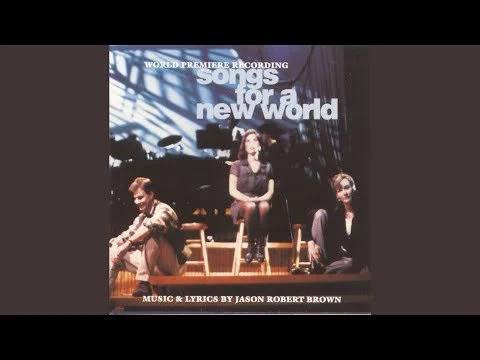
For this week’s Track by Track, we are going back to one of those cast recordings that did not just live in your CD binder in the early 2000s. It became part of your personality.
For a very specific generation of musical theatre kids, Songs for a New World was one of those albums. It was not just a recording. It was a Bible. It was passed around dorm rooms, burned onto mix CDs, uploaded to iPods, and treated like sacred text by anyone with very strong feelings about Jason Robert Brown’s chord progressions.
The 1996 Off-Broadway recording features much of the show’s original cast, including Brooks Ashmanskas, Andréa Burns, and Jessica Molaskey. One notable exception is Billy Porter, who appeared in the original production but was unable to appear on the recording. In his place, Ty Taylor stepped in, and frankly, he gives a performance that makes you very grateful this album preserved his work, too.
Before every contemporary musical theatre audition, folders contained the same 12 songs; this album felt like a discovery. It had drama. It had humor. It had impossible piano parts(sorry to the many audition pianists who had to deal with this).
And maybe that is why Songs for a New World still has such a hold on people who found it back then. It was sophisticated enough to make us feel grown up, emotional enough to make us feel understood, and theatrical enough to make us believe that every crisis in our lives deserved a modulation.
Jason Robert Brown’s song cycle has always occupied an interesting place in musical theatre. It is not quite a traditional musical, not quite a revue, and not quite as abstract as people sometimes make it sound. The idea is actually pretty simple: every song captures a moment of decision, when someone is standing at the edge of change and has to step into a new world.
These are songs about fear, ambition, regret, longing, ego, survival, faith, and the terrifying realization that life can change direction in a single second.
In other words, perfect listening material for any 20-year-old theatre kid in the early 2000s, convinced that every minor inconvenience was actually an eleven o’clock number waiting to happen. Let’s dig in.
Opening / The New World
This opening number is basically the thesis statement of the entire show. We are not being introduced to characters in the traditional sense. Instead, we are dropped into a feeling. That terrifying, electric moment when life shifts beneath your feet and you realize the world you knew is gone, or at least no longer enough.
The cast sounds fantastic here. Brooks Ashmanskas, Andréa Burns, Jessica Molaskey, and Ty Taylor blend beautifully, but they also each bring a distinct emotional color to the song.
There is also something wonderfully dramatic about how quickly the song builds. As an opener, it still works because it makes a promise the rest of the album actually keeps.
On the Deck of a Spanish Sailing Ship, 1492
What makes this song work is that it completely commits to its own size. There is nothing coy about it. Ty Taylor sings it with such force and urgency that you understand immediately why this album became sacred text for young musical theatre singers.
But beneath all the grandeur, the song is doing something very specific. It is not just about discovery or adventure. It is about desperation. These men are hungry, frightened, worn down, and clinging to the possibility that somewhere ahead of them is a life that will make all of this suffering mean something.
That is the emotional engine of the song, and Taylor understands that. There is power in his voice, but there is also fear underneath it, which keeps the song from becoming one giant vocal flex. This is one of those Brown songs where a less thoughtful performer might hear the music and decide the assignment is “loud.” Taylor finds the ache inside the volume.
The ensemble work is also key here.
Just One Step
And then, after all that sea-sprayed desperation, we get “Just One Step,” which is essentially what happens when a Manhattan marriage crisis gets a torch song, a punchline, and a ledge.
This is one of the great tonal pivots on the album. We go from men praying for deliverance on the open ocean to a wealthy woman standing outside her apartment window, threatening to jump unless her husband finally pays attention to her. On paper, that sounds impossible. On the recording, it works because Jessica Molaskey knows exactly what song she is in.
“Just One Step” is funny, but it is not just funny. That is the trick. The character is ridiculous, sure, but she is not a joke. She is lonely. She is furious. She is theatrical because no other language has worked. At some point, she has decided that if her husband will not listen to her in the living room, maybe he will listen when she is dangling above Fifth Avenue.
I’m Not Afraid of Anything
“I’m Not Afraid of Anything” is one of those songs that has been sung in plenty of audition rooms, but weirdly, I still think it might be underrated as an audition piece.
That may sound odd because theatre people know the song, but it does not feel quite as overdone now as some of the other songs on this recording.
On the surface, this is a song about bravery. The narrator tells us, over and over again, that she is not afraid. She is fine. Completely fine. Nothing to see here. Please do not look too closely at the woman loudly explaining how fearless she is.
Of course, that is what makes the song work. It is not really about fearlessness. It is about someone who has built an entire identity around being untouchable, only to realize that maybe being untouchable has cost her something.
Andréa Burns gives the song a beautiful clarity. She does not overplay the contradiction. She lets the confidence sit there first, bright and clean, before the cracks start showing.
The writing is also very smart. Brown gives the character all these declarations of strength, but the music keeps suggesting something softer underneath. The more she insists she is not afraid, the more obvious it becomes that she is terrified of the one thing that actually matters: letting herself need someone.
That is what makes this song more than a useful audition piece. It is not just a chance to show range or sustained notes or tasteful vulnerability. It is a character study in self-protection.
The River Won’t Flow
After the grandness of “Spanish Sailing Ship,” the comic panic of “Just One Step,” and the emotional armor of “I’m Not Afraid of Anything,” this song pulls the album into a more cynical place. “The River Won’t Flow” is not about a beautiful leap into destiny. It is about being stuck.
Brooks Ashmanskas and Ty Taylor give the song a great, rough-edged chemistry. They sound weary, irritated, and completely fed up, which is exactly what the number needs.
It may not be the track people immediately name when they talk about this recording, but it adds texture. It keeps the album from becoming too polished, too earnest, or too inspirational. Because as much as Songs for a New World is about hope and possibility, it is also about disappointment. And disappointment deserves a song too.
Stars and the Moon
And now we arrive at the big one. “Stars and the Moon” is probably the most famous song from Songs for a New World, and for good reason. It is one of those pieces that feels so simple on the surface that you almost forget how brilliantly constructed it is.
A woman tells us about three men. One offered her romance and poetry. One offered her adventure and passion. One offered her money, comfort, and security. She chooses the third, gets exactly what she thought she wanted, and then spends the rest of the song quietly realizing what that choice cost her.
That is the killer of “Stars and the Moon.”
Jessica Molaskey sings it beautifully because she does not turn it into a sob story. This is not a woman falling apart in front of us. This is a woman who has had years to live with her decision, years to dress it up as practicality, years to tell herself she made the adult choice. The heartbreak comes from the fact that she knows better now, and she cannot go back.
It is also a perfect example of why Jason Robert Brown’s writing hit theatre kids so hard. He has a real gift for writing songs that feel like complete short stories. You get the character, the history, the turn, and the emotional consequence, all in one tidy little package that then ruins your day.
She Cries
What I like about “She Cries” is that it is not just a male angst song. This man is in a relationship with someone whose pain overwhelms him. He loves her, or at least he thinks he does, but he cannot fix her. He cannot even fully understand her. All he can do is stand there and watch the emotional weather roll in.
Brooks Ashmanskas gives the song a nice sense of vulnerability without making it too precious. He does not sing it like a man nobly suffering through someone else’s sadness. He sings it like someone who is genuinely confused by how much power another person’s pain has over him.
The Steam Train
“The Steam Train” is where the album throws open the doors and lets Ty Taylor absolutely cook. And nothing against Taylor but I would have loved to hear Porter’s take on it.
There is such urgency in the way Taylor performs it. You can hear the hunger. You can hear the need to get out, get seen, get somewhere bigger than the place that has been assigned to him. It is one of those performances where the confidence is thrilling, but the vulnerability underneath is what makes it land. He is not just bragging. He is building a future out loud.
It is also another reminder that this recording is not for the vocally timid. Jason Robert Brown writes like he believes singers have extra lungs hidden somewhere, and Ty Taylor performs this as if he is determined to prove him right.
The World Was Dancing
“The World Was Dancing” is one of the most underrated songs on this recording, which is saying something because Songs for a New World has a few tracks that tend to hog the spotlight.
And funny enough, this is the song on the album most likely to make me cry.
It begins with a man looking back on his parents’ relationship, specifically the night his father met his mother. It has that loose, almost conversational quality of someone telling a family story they have carried around for years, not fully realizing how much it has shaped them until the words start coming out.
And that is what makes the song so moving. It is not just nostalgia. It is inherited longing.
Brooks Ashmanskas gives it a lovely tenderness. You get the sense that he is not simply admiring his parents’ love story. He is measuring his own life against it. Then Andréa Burns enters, and the song shifts into something even more delicate.
The song gets me because it is not only about love. It is about wanting a life that feels as meaningful as the stories we were told. It is about realizing that maybe the world does not start dancing on its own. Maybe you have to choose to hear the music. That is the kind of emotional ache that this album does so well.
Surabaya-Santa
This song is ridiculous. I also kind of love it.
Let’s be honest. This song is also wildly random in the context of the show. Songs for a New World gives us sailors facing the unknown, lovers making life-altering choices, people wrestling with fear, faith, ambition, regret, and survival, and then suddenly, here comes Mrs. Claus ready to drag her husband for being emotionally unavailable. It is a tonal left turn so sharp you may need to check your neck afterward.
But that randomness is also part of the charm.
A huge part of why the track survives is Jessica Molaskey, who understands that the only way to make “Surabaya-Santa” work is to commit to it completely. Molaskey treats the absurdity with absolute seriousness, which is exactly why it becomes funny.
“Surabaya-Santa” is the kind of track that makes you stop and ask, “Wait, what show are we in again?” But by the end, you are usually glad it showed up.
Christmas Lullaby
After the glorious whiplash of “Surabaya-Santa,” “Christmas Lullaby” arrives like the album quietly apologizing for what just happened.
And honestly, it is a beautiful reset.
It also kicks off what may be the strongest stretch of the entire recording. The next six songs are basically a master class in Jason Robert Brown’s range as a writer.
“Christmas Lullaby” is one of the gentlest songs on the recording, and Andréa Burns sings it with such warmth. It is earnest. It is hopeful. It is about pregnancy, faith, and a woman seeing herself in the story of Mary.
And I’ll say it: this might be Andréa Burns’ best recorded performance of anything she has ever done.
What makes “Christmas Lullaby” work is that it is not just about religion or motherhood in some grand, abstract way. It is about someone trying to understand the enormity of what is happening to her.
King of the World
This is the song we all thought we could sing. We could not.
But that did not stop us from trying in our cars, bathrooms, dorm rooms, empty rehearsal studios, and anywhere else we could emotionally terrorize drywall. For a certain kind of musical theatre kid, “King of the World” was not just a song. It was a challenge. It was a dare(the same for our audition pianists). It was the track that made you think, “Maybe I do have that note,” only to discover somewhere around the second chorus that you very much did not.
And that is part of its legend.
Ty Taylor is phenomenal here. He lets the anger build from something wounded into something almost volcanic. You hear the frustration, but you also hear the intelligence underneath it. This is not a man throwing a tantrum. This is a man who understands exactly what has been taken from him.
“King of the World” is enormous, demanding, and maybe a little dangerous to attempt without proper hydration. But when sung like this, it is thrilling.
I’d Give It All for You
Brooks Ashmanskas and Andréa Burns are lovely together here. There is a warmth in their voices that makes the relationship feel lived in, not freshly manufactured for a duet. You believe there was something between these two before the song began. You believe they tried to move on. You believe they may have even convinced themselves they had.
And then, inconveniently, feelings.
What I love about the song is that it gives the album one of its most straightforward emotional payoffs. Jason Robert Brown can be rhythmically tricky, harmonically demanding, and emotionally complicated, but here he lets the melody do something beautifully direct. Two people want each other. Two people realize the other life was not enough. Two people stand at the edge of another new world and decide, maybe foolishly, maybe wonderfully, to step toward each other.
Is it the most complex number on the recording? Probably not. But it does not need to be. Sometimes emotional clarity is the point. Sometimes a duet just needs to make you believe two people would wreck their carefully arranged lives for one more chance.
“I’d Give It All for You” does that beautifully. It is sweeping, sincere, and just theatrical enough to make you forgive every questionable decision these two people are probably about to make after the blackout.
The Flagmaker, 1775
“The Flagmaker, 1775” is one of those songs that can get overlooked on this recording, which is a shame because it is quietly one of the strongest pieces of writing in the entire score.
Jessica Molaskey gives a performance here that is all restraint, which is exactly why it works. She is not playing some grand patriotic symbol. She is playing a woman trying to keep her hands busy because if she stops, she may have to fully feel the terror of what is happening around her. Her husband is gone. Her son is gone. The country is being born in violence and uncertainty, and she is left at home stitching together a symbol of hope while privately wondering how much that hope is going to cost her.
“The Flagmaker, 1775” may not be the track people rush to sing at cabaret night, but it is one of the reasons this album has held up. It proves that Jason Robert Brown does not need volume to create stakes.
Flying Home
“Flying Home” is where the recording starts to feel more like a spiritual release.
This song arrives with a different kind of gravity. It is about death, yes, but it does not feel morbid. It feels like crossing over. It feels like someone loosening their grip on the world and trusting that whatever comes next might be gentle.
Ty Taylor leads it beautifully. He sings like a farewell that has finally found peace. And the ensemble work here is gorgeous. By this point in the album, these four voices feel like they have been through something together.
What I love most about “Flying Home” is how it expands the idea of the “new world” one more time. Earlier in the album, a new world meant adventure, escape, love, ambition, motherhood, freedom, or revolution. Here, it means the final unknown. The last crossing. The one nobody gets to avoid.
It is also one of the moments where you really feel why this final stretch of the recording is so strong. Tenderness, rage, romance, fear, grief, release. Jason Robert Brown really said, “What if I made everyone emotionally unstable for the last twenty-five minutes?” and honestly, mission accomplished.
Hear My Song
And then we arrive at “Hear My Song,” which is basically the album’s final hand on your shoulder.
After all the fear, ambition, grief, romance, rage, regret, and whatever exactly Mrs. Claus was going through, “Hear My Song” brings everything back to something simple: keep going.
It is easy for a finale like this to become sentimental, and honestly, this song gets close. But on this recording, it earns it.
The cast sounds gorgeous here. They all bring a kind of warmth to the finale that makes it feel communal, almost like the whole album has been building toward this one shared breath. After so many individual moments of crisis, this song lets the voices come together and offer something like comfort.
“Hear My Song” may not be the flashiest track. It may not be the one people rush to sing in auditions. But as a closing statement, it does exactly what it needs to do. It opens the door, points toward the horizon, and says: go.
Who wins this recording?
Ty Taylor wins this recording. That is not a knock on the rest of the cast, because Brooks Ashmanskas, Andréa Burns, and Jessica Molaskey are all doing exceptional work here.
But Ty Taylor walks into this album with “On the Deck of a Spanish Sailing Ship, 1492,” “The Steam Train,” “King of the World,” and “Flying Home,” and somehow makes every single one feel like an event.
That is a ridiculous assignment. Those songs require power, control, storytelling, stamina, range, and the ability to sound like you are singing from the edge of human possibility without actually losing the thread. Taylor does all of that.
As I said earlier, for a generation of musical theatre kids, this recording became a Bible. And Ty Taylor is a big reason why.
Which song gets cut? – “Surabaya-Santa”
Honestly? None of them.
That feels like a cop-out, but with Songs for a New World, every track is doing something specific. But for the purposes of this column, if I have to cut one, it is “Surabaya-Santa.”
I say that with affection, because I do enjoy it. It is bizarre. It is funny. Jessica Molaskey absolutely commits. And as a standalone cabaret-style number, it has real bite and personality.
But in the larger arc of the album, it is also the track most likely to make you stop and think, “Wait, did my CD skip to another show?”
So no, I do not actually want to cut it. I would feel bad. Mrs. Claus has clearly been through enough.
But if the column demands a choice, “Surabaya-Santa” is the one.
Best in the Show – “I’m Not Afraid of Anything”
This may be an upset, because, for many, the obvious answer is “Stars and the Moon.”
And listen, I get it. “Stars and the Moon” is famous for a reason.
But for me, Best in Show goes to “I’m Not Afraid of Anything.”
There is something about that song that feels like the emotional center of the album. It captures the entire idea of Songs for a New World in such a clean and human way.
It is also a fantastic performance from Andréa Burns.
“Stars and the Moon” is brilliant, but “I’m Not Afraid of Anything” feels a little more alive every time I hear it.
“I’m Not Afraid of Anything” gets my Best in the Show, which means it is going on the Best in the Show playlist. It is deceptively simple, beautifully performed, and still one of the best songs Jason Robert Brown has ever written about someone lying to themselves with perfect pitch.