
LOS ANGELES (RNS) — Sister Teresa Groth calls herself a “pardoned sinner” who seeks to be “an instrument of mercy in the hands of God” — words paraphrased from the constitution of the Daughters of Mary and Joseph, her congregation. As executive director of Francisco Homes, a Los Angeles housing program for formerly incarcerated men, she says that calling has guided her work. Since 2009, Groth has been welcoming men who served long sentences and easing their transition back into the world.
Groth came to religious life later than most. Widowed at 30 with a baby, she said she threw herself into her parish and, in her early 30s, had a religious experience she describes as God addressing her guilt directly: “Just rest in my love. Trust me.” After her son left for college, she entered the Daughters of Mary and Joseph and came to Francisco Homes in her second year of formation. “First, we recognize that we have received mercy. I have received mercy,” Groth, 70, said.
Founded in 2007 as an extension of a project of the office of restorative justice of the Archdiocese of Los Angeles, the Francisco Homes houses as many as 95 residents in 10 homes in Los Angeles. In addition to transitional and permanent housing, Francisco Homes also provides residents with reentry services, such as help signing up for food assistance and health insurance and obtaining a cellphone. The resident guides, or case managers, also help residents set personal and work goals, and there are in-house programs such as Alcoholics Anonymous and Narcotics Anonymous, and groups for spiritual reflection. On average, the residents have served sentences lasting 28 years and stay in the housing for 12 months.
But some immigrants face the possibility of deportation upon release from prison or while they’re at Francisco Homes. In the U.S., if a noncitizen — even one with legal status — is convicted of a serious crime, the government considers that person to have violated the terms of residency, making them deportable. As the threat of deportation increases for all immigrants, Catholic bishops as well as immigrant advocates have pushed back on the mass deportation campaign, saying deportations should be reserved for convicted criminals. That position has left Groth largely on her own in advocating they receive a merciful approach.

Sister Teresa Groth. (RNS photo/Aleja Hertzler-McCain)
Even her archbishop, Los Angeles’ José Gomez, argued that deportations should be limited to “violent criminals or those guilty of other serious offenses.” Groth said she didn’t think Gomez was referring to the men in Francisco Homes. “I don’t think he meant it personally to anyone,” said Groth. “Looking at them in their eyes at the Francisco Homes, saying, ‘Yeah, I think you should not be receiving any help.’ I don’t think he meant that.”
Groth said that for the majority of the people she works with, their offense “was not something that they would have chosen in their right mind. It was not a path they chose.”
The idea that immigrants bring crime to the U.S. has a long history in American politics. It has also been a central theme of President Donald Trump’s rhetoric since his first presidential campaign. But studies have repeatedly shown that immigrants, including those without legal status, commit crimes at lower rates than people born in the U.S.
”(It) was not something that they would have chosen in their right mind. It was not a path they chose.”
Sister Teresa Groth
Sitting beside Groth in her small office in a light yellow house on a shady neighborhood street in South Los Angeles, one of the residents, Arturo, tells his life story — abused by his family from his earliest memories, he first ran away at 13 — that seems to underscore her point. “I thought running away would help me, joining the gang would help me, being in a relationship would help me. But none of that would help me. I was broken in every way, and I broke other people’s lives,” he said, anxiously fiddling with the skin at his throat and staring into the distance.
Arturo said he began to hear voices after he broke into the car of a fellow East Side Wilmas gang member and couldn’t pay him back. He thinks he was drugged in retaliation. “I woke up in front of a house, in front of a porch with my pants down in really bad pain. I checked myself. I was bleeding,” he said.
Eventually convicted of carjacking and arson, he served 12 and a half years in prison, where he said he was sexually assaulted again.
Born in Tamaulipas, Mexico, and sent to the U.S. when he was 5, Arturo was a legal resident when convicted and spent 15 months in immigration detention upon release from prison. He went to Francisco Homes after being released on bond, though he is still at risk of deportation. Unlike most detainees, Arturo qualified for government-provided legal representation because of a court ruling mandating the representation for detainees with mental disabilities in Arizona, California and Washington. He said he has been diagnosed with major depression, schizoaffective disorder and post-traumatic stress disorder.
Coming to Francisco Homes was life-altering. “When I got here, they gave me a hug, and they told me welcome home,” said Arturo, who agreed to be interviewed on the condition that RNS use only his middle name. He began attending Narcotics Anonymous, Criminals and Gangmembers Anonymous and the spiritual reflections led by Groth, which he said “helps me so much. It’s a blessing to hear her share.” Now, after almost a year, Arturo, 49, has his work permit and two part-time jobs. He began singing at church. And he’s working on his relationships with his mother and two of his five kids.

Francisco Homes in Los Angeles. (RNS photo/Aleja Hertzler-McCain)
For most of the noncitizens who apply to Francisco Homes, their decades-long prison sentences are not the last consequence for their actions. They face the threat of deportation; they’ve already been separated from their families by prison, and deportation would separate them again. “Now we will ban you from the only country you have known,” said Groth.
M. Pérez, who agreed to be interviewed on the condition he be identified by an initial and one last name, was a legal resident before he was convicted after driving while intoxicated and killing two people.
Speaking in Spanish, he told RNS that he began drinking and smoking marijuana when he was a teen, resentful that his parents moved him and the family back to their home city of Veracruz, Mexico. Arriving in the U.S. at the age of 21, he said he eventually became addicted to crystal methamphetamine and began to hear voices that urged him toward two suicide attempts and then his intoxicated crash.
Pérez spent 11 days in a coma and had a broken leg, arm and nose, and his lungs collapsed. Accepting help from other incarcerated people in prison to eat and bathe broke his pride, but it was also part of a rebirth, he said.
“I cried from gratitude, and I think all of that helped me to change my thinking and begin to live more correctly,” Pérez said. “I could only see the hand of God in everything.”
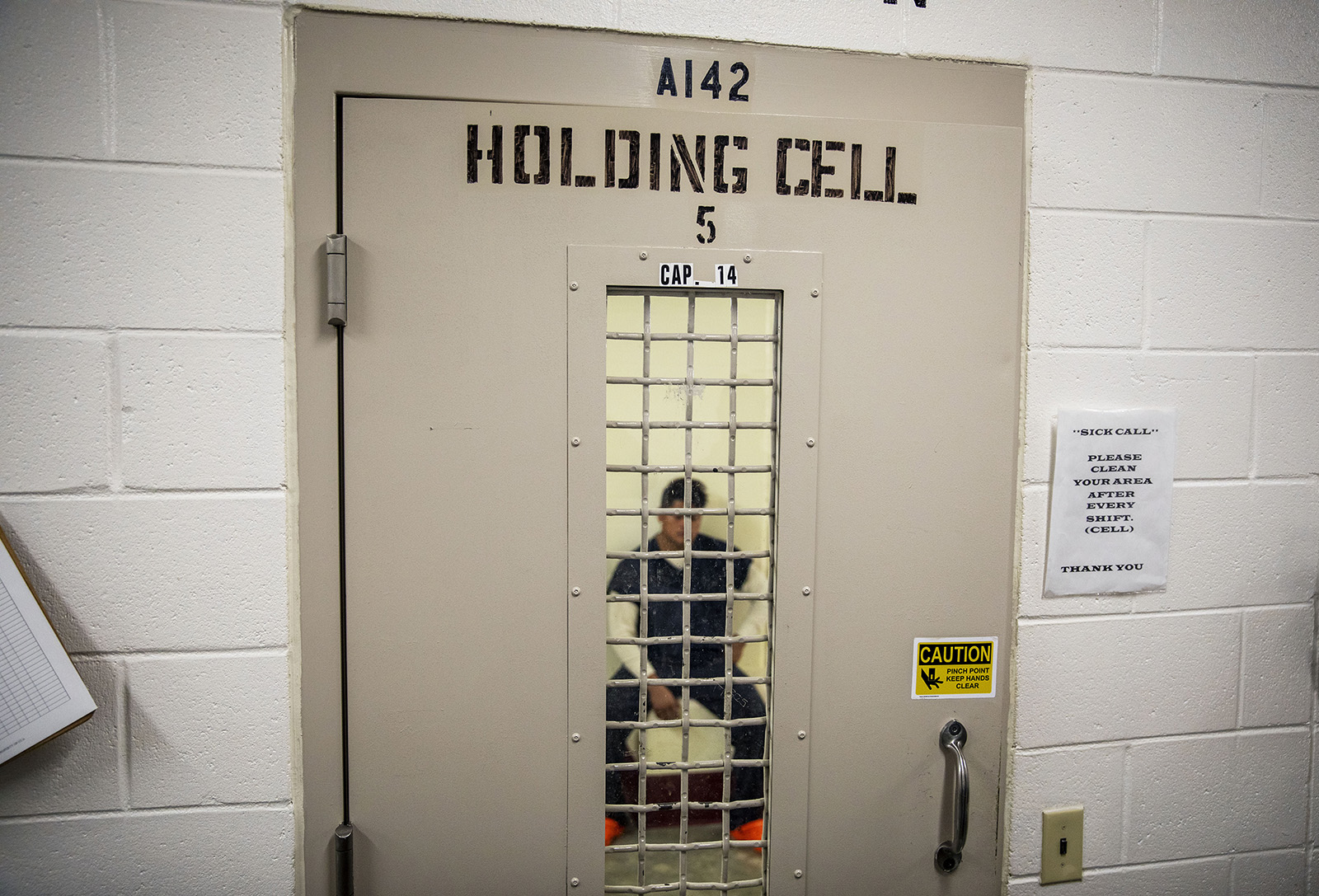
A detainee sits in a holding cell at the Stewart Detention Center, Nov. 15, 2019, in Lumpkin, Ga. (AP Photo/David Goldman)
He also sees God’s mercy in the miracle that he wasn’t deported upon leaving prison, giving him time to connect with his family. “I know whatever change of any kind comes from God.” He explained his thinking: “I don’t think about what could happen tomorrow or the day after. It’s just — today I had the opportunity to get up, walk and start this day, and I try to live it the best I can, in the best way.”
As Arturo fights deportation proceedings, he became certified as a substance abuse peer counselor. “I want to help people, like Sister Teresa,” he said. “God willing, one day I have this vision of opening up a church called Hunger for the Father.” Groth recently offered Arturo an internship.
For her part, Groth sees the power of mercy and urges people, especially people of faith, to “embrace God’s love for what it is — that’s so big. When we feel loved, we act differently.”