
Key takeaways
- Economists are confident that the housing market is not going to crash. Instead, it’s undergoing a correction that will likely take many years.
- Home prices have continued to climb even as sales activity has slowed, largely due to an inventory shortage—not a bubble waiting to burst.
- Lending standards are much stricter than they were before the Great Recession, reducing the risk of a credit-driven collapse.
- Even so, homebuyers and sellers are feeling the strain of an unaffordable housing market and volatile economic policies.
Today, the housing market feels stuck. Buyers are frozen out by high prices and elevated mortgage rates. Sellers are reluctant to list because they don’t want to give up low-rate mortgages and worry they won’t find a buyer. As a result, sales are slow and price cuts are more common. Consumers are concerned about how dramatically the market has flipped from hot to cold.
But most economists are confident that the economy is actually undergoing a long-term correction, not spiraling out of control. The last real estate crash in the U.S. happened during the Great Recession nearly two decades ago, when a housing bubble fueled by risky lending triggered a collapse. Today’s market looks fundamentally different.
So, if you’re a buyer or seller stuck on the sidelines wondering if the housing market is going to crash, this article is for you. Let’s break down what a housing market crash looks like, why economists are confident we don’t need to worry, and why buyers and sellers are on edge.
From Redfin’s Chief Economist
“We’re in the middle of a long-term housing market correction, not a housing market crash. After the pandemic-era frenzy sent prices soaring and inventory to historic lows, the market needed a reset. What we’re seeing now is not a sudden collapse but a yearslong comedown: slower sales, flatter prices in many metros, and buyers getting leverage.” – Daryl Fairweather, Redfin Chief Economist
>> Read: Redfin’s 2026 Predictions: Welcome to The Great Housing Reset
What is a housing market crash?
A housing market crash is a sudden, sharp, widespread drop in home values. Crashes usually stem from broader economic or financial shocks, like a recession, a surge in speculative lending, high inflation, or rising unemployment. Those pressures can quickly spill into housing, triggering oversupply or a sharp drop in demand.
During a crash, several things typically happen at the same time:
- Home prices fall quickly across the nation
- Buyer demand drops, often due to job losses, high interest rates, or delinquency
- Home sales slow sharply
- Foreclosures and mortgage defaults increase as homeowners struggle to keep up with payments
Housing crashes rarely happen in isolation. They’re usually tied to broader economic shifts, such as recessions, financial crises, or risky lending practices. The last true real estate crash in the U.S. happened during the 2008–2009 Great Recession, which was linked to a burst housing bubble and mortgage lending crisis.
Why the housing market is unlikely to crash
While the housing market today is slow, expensive, and marred by global economic uncertainty, experts are confident that the housing market is not going to crash. Instead, it’s experiencing a prolonged “reset” from the pandemic, when house prices and inflation skyrocketed.
“The idea that there’s a crash just around the corner is a narrative that forms whenever the economy goes through a seismic shift,” said Chen Zhao, Redfin Head of Economics Research. “But today, signs are pointing to a relatively stable reset: Prices are leveling out, mortgage rates are steady, construction is rising, and affordability is improving. But the market is still very difficult, so it’s natural for people to worry.”
Let’s dive a bit deeper into why economists believe housing isn’t heading toward a crash.
Home prices are rising more slowly, and will likely level out
Before a crash, you might see home prices spike sharply and then suddenly plunge as a housing bubble bursts. That’s not what we’re seeing today. While prices are still rising in many markets, the pace of growth has slowed to around 1%, and most analysts expect prices to flatten in 2026 and beyond as the market continues to adjust.
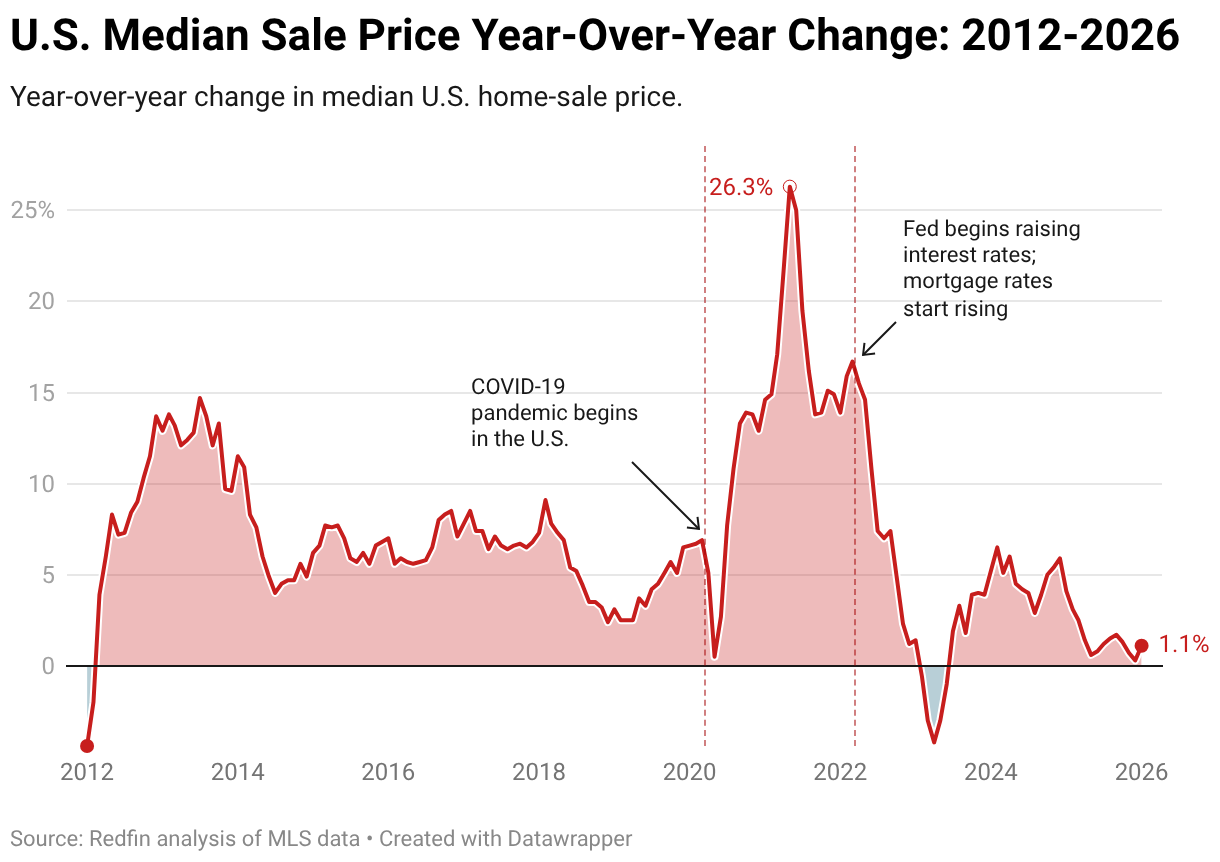
Of course, there are regional exceptions. Parts of the Midwest and Northeast with relatively affordable housing and limited inventory are still seeing price growth. Meanwhile, prices are falling in a few overheated markets in the Sun Belt, notably Austin, which has flipped from the hottest to the coldest market in the nation.
Mortgage rates are settling into a new normal
A sudden increase or decrease in mortgage rates can trigger major shifts in the housing market, like a surge in demand or sharp drop in listings. That’s very unlikely to happen today, barring dramatic action from the Trump Administration. While rates remain elevated compared to pandemic lows, they have stabilized relative to the rapid increases seen in 2022 and 2023.
“It’s unclear exactly what would happen if rates dropped dramatically—but we probably wouldn’t see a surge in prices,” continued Zhao. “One reason is because a drop in rates would likely mean the economy is in a recession, which would limit buyers’ spending power. Another is because more supply might hit the market as sellers become “unlocked” from their pandemic-era rates. This is already beginning to happen: The share of homeowners with mortgage rates above 6% now outnumbers those with rates below 3%, which is creating a slow increase in inventory.”
The labor market is relatively strong
Unemployment and job growth have an outsized impact on the housing market. Mass layoffs and rising unemployment are two of the main triggers of housing crashes, because they can lead to missed mortgage payments, forced sales, and rising foreclosures. When a lot of people quickly lose their income, housing demand often drops—and supply spikes as financially strained homeowners are forced to sell.
That’s not what we’re seeing today.
“The job market has been holding up relatively well, which is why we aren’t seeing a surge in foreclosures or delinquencies,” added Zhao. “There are some worrying signals that employment could shift in the future—especially surrounding the rise of artificial intelligence (AI), and job growth that has almost exclusively been concentrated in healthcare. But stable employment is a key reason economists don’t expect a wave of foreclosures or distressed sales.”
There are stricter lending requirements
Regulations put in place after the 2008 financial crisis tightened mortgage lending standards to reduce risky loans and prevent another broad mortgage-credit collapse. These rules—like requiring banks to hold more money in reserve to cover potential lending losses—make it less likely that credit alone will ignite another crash.
“We are unlikely to see another credit-induced economic collapse given the strict lending standards set in 2010 and strengthened in 2024,” noted Fairweather. “Stronger oversight and more transparent underwriting makes the housing market far more resilient than it was two decades ago.”
Why buyers and sellers are worried about a housing market crash
Even though a real estate crash is unlikely, everyday Americans are still dealing with the effects of a volatile and very unaffordable housing market—especially younger generations.
To better understand the difficulties, let’s break down some key data behind today’s market.
The pandemic housing boom and bust
The pandemic threw the housing market off kilter and gave buyers and sellers a major case of whiplash, which prompted some experts to fear that a crash was possible.
Real estate activity grinded to a halt in early 2020 before skyrocketing to record heights in 2021-2022, as remote work and ultra-low mortgage rates unleashed a buying frenzy centered in the Sun Belt. But when mortgage rates spiked and affordability collapsed in 2022–2023 due to historic inflation, demand fell sharply.
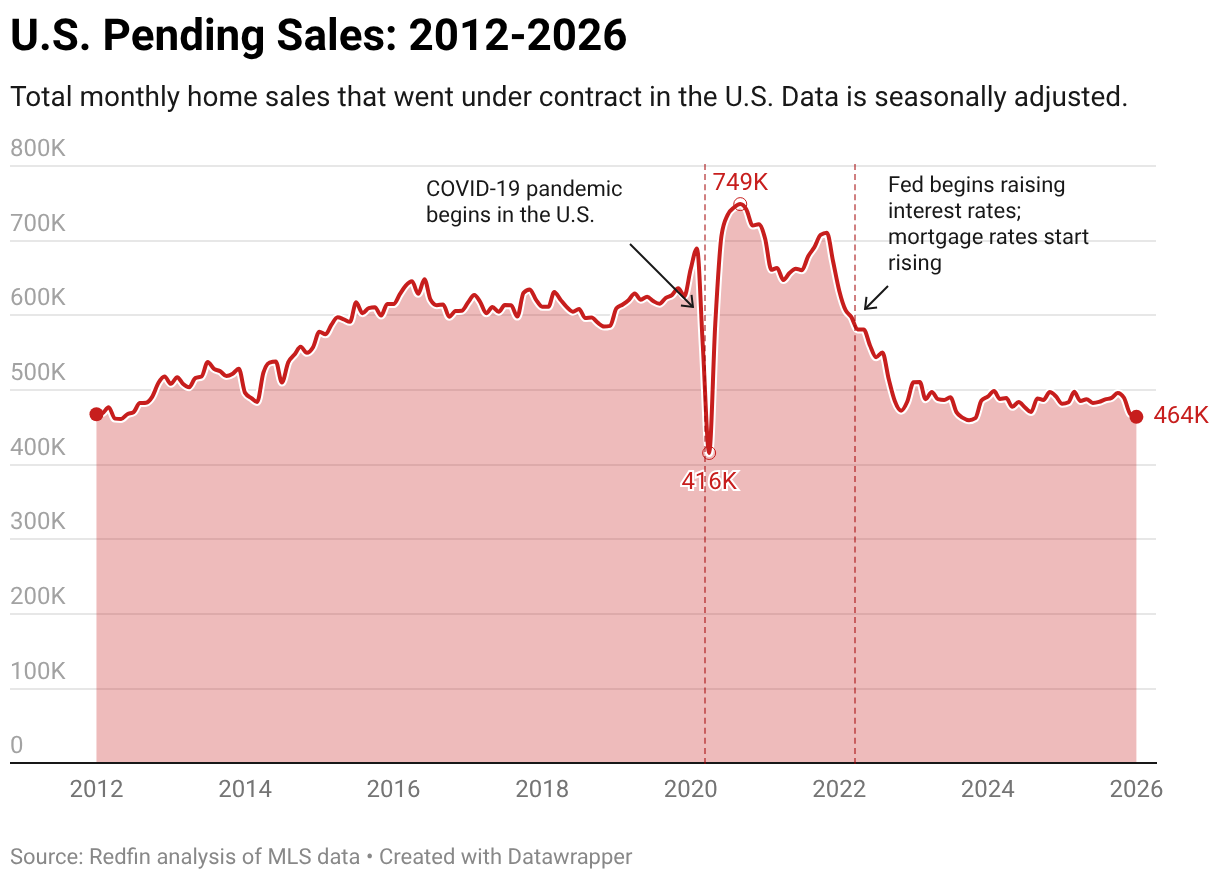
Today, the housing market has slowed to a crawl, with buyers priced out and sellers waiting for activity to return. Price cuts are fairly common nationwide and regular in the Sun Belt where most people moved during the pandemic—especially Austin, Nashville, and San Antonio.
There are still some outlier cities clustered in the Midwest and Northeast where homes are selling like hot cakes and prices are rising, like Buffalo and Milwaukee. But that’s largely because they are more affordable and have a smaller pool of homes for buyers to choose from.
A potential “housing bubble”
Home prices have hit new monthly records for more than two years in a row, raising concerns about whether real estate is in “bubble” territory—when prices are unsustainably inflated. Plus, even though price growth has slowed from the breakneck pace of the pandemic, prices themselves are still rising and remain near record highs in many parts of the country. A major inventory shortage is largely to blame—which is steadily improving.
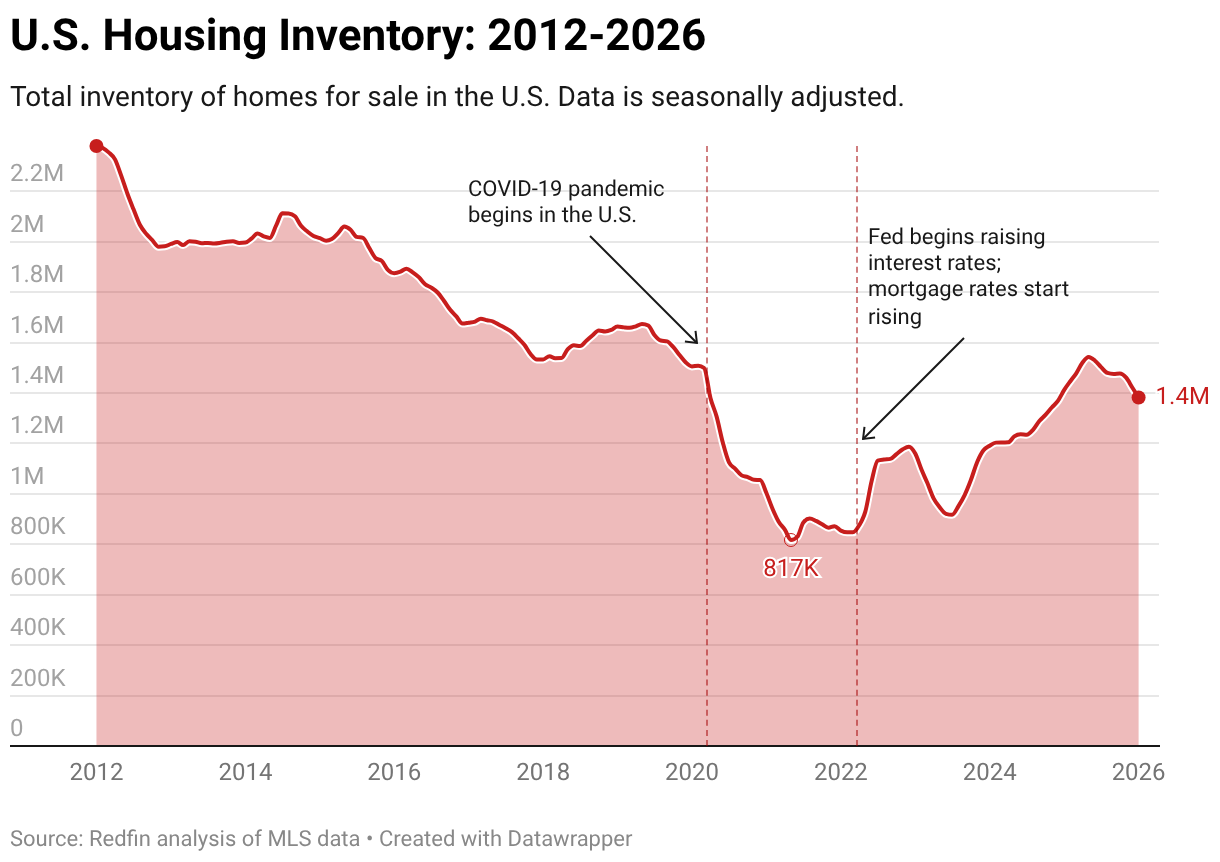
However, a few experts have noted that the larger problem may be a shortage of affordable homes. Those who can afford a home today are often still buying, but most consumers are simply priced out.
Record-low affordability and economic unease
Maybe most importantly, Americans are living through a prolonged period of uncertainty and record-low affordability. Elevated mortgage rates, stubbornly high home prices, and broad economic anxiety have made housing feel out of reach for many people.
According to Redfin data, the typical homebuyer spends about 34% of their income on housing (as of January 2026), while home prices have risen roughly 40% since the pandemic.
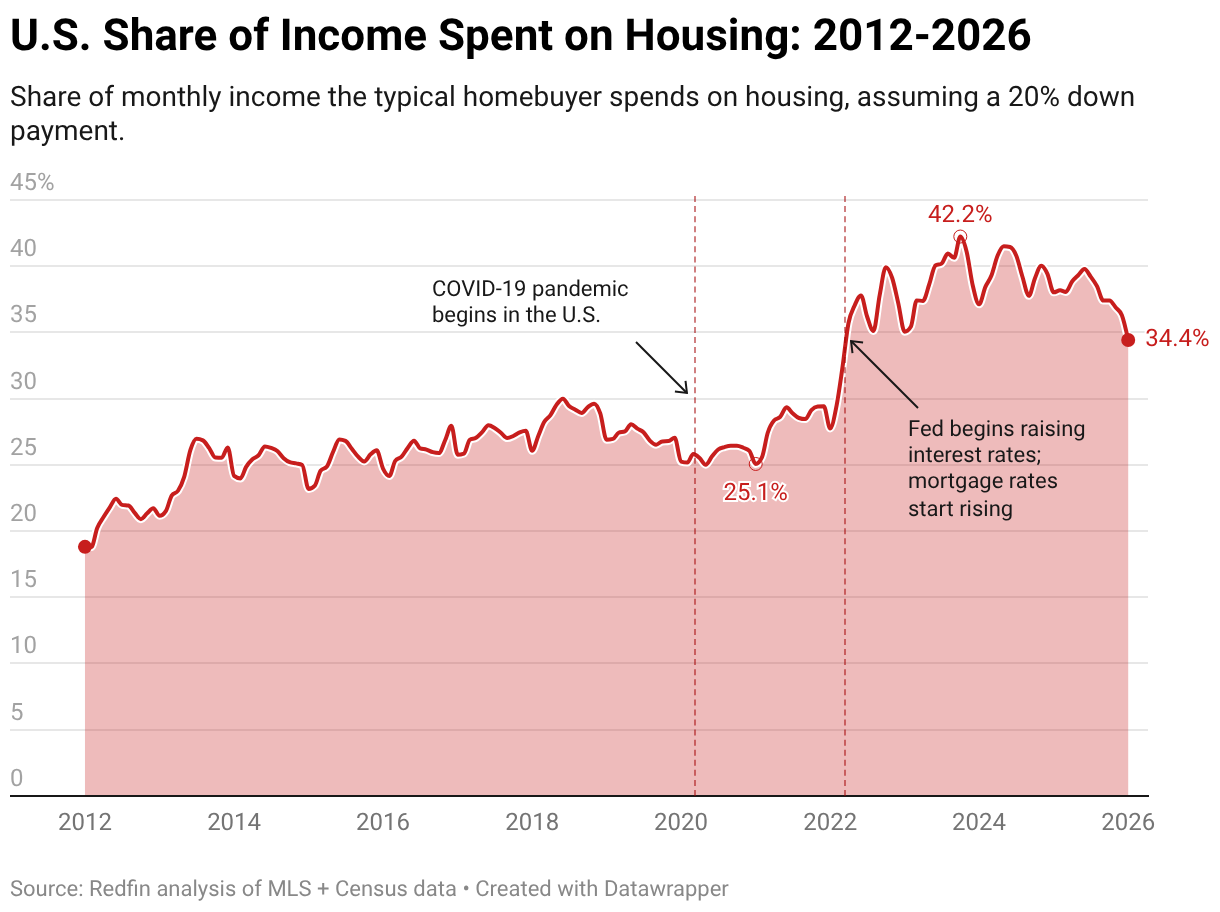
But affordability is starting to improve as price growth slows and wages rise. And it’s possible that prices will return to “normal” by 2030, meaning a median earner will be able to afford a median-priced house spending 30% of their income on monthly payments.
Even so, the mix of financial pressure and uncertainty is reshaping how buyers and sellers behave. It’s one of the biggest reasons the market feels so unstable, even without the signs of a bubble bursting.
Is commercial real estate crashing?
Unlike the residential real estate industry, commercial real estate (CRE) has been grappling with a prolonged downturn that began in March 2020. It’s not necessarily crashing, but it is struggling.
When the pandemic hit, most in-person activity shut down almost overnight. This led to a sudden jump in remote work, an online shopping boom, and a change in spending habits due to inflation. These changes, plus spiking interest rates, weighed heavily on office buildings and big box stores and dramatically reduced demand for commercial real estate. Trends have persisted, pushing office mortgage delinquencies to record highs—even as remote work fades.
Adding another layer of uncertainty, the rapid rise of artificial intelligence (AI) is beginning to shape investor sentiment in the sector. Some investors are increasingly wary of industries seen as more exposed to AI-driven workforce changes—notably, entry-level white-collar roles at tech companies that lease or own commercial real estate.
“Commercial real estate has been caught in the crossfire of multiple major economic shifts, and it’s feeling the effects,” continued Fairweather. “To adapt, some companies and cities have tried to find innovative ways to convert vacant office buildings into residential buildings, which is positive on paper. But zoning restrictions and the cost of conversion have prevented this from becoming widespread. If current trends continue, it will take quite a while for the industry to recover.”
It’s worth noting that the CRE downturn is nowhere near as strong as the 2008-2009 Great Recession or prolonged valuation pressures of the 1980s and early 1990s. Today, stress is more concentrated in specific property types and tied to structural shifts in work and interest rates rather than a broad financial crisis.
The bottom line: The housing market is undergoing a correction, but it is not crashing
The housing market is most likely not heading toward a crash. Instead, it’s undergoing a long-term correction. A housing market correction is a slower, often uneven normalization in prices, inventory, demand, and other economic factors.
Today, prices are flat or falling in many overheated markets, sales are slower, inventory is building, and buyers have more negotiating power. There isn’t the wave of foreclosures, plummeting home values, or systemic financial stress that defines a crash. For some buyers who can afford to buy now, today’s market may offer more opportunities than the highly competitive conditions of the early 2020s.
It’s hard to say what the future will look like. But if current housing trends continue, the housing market will become more accessible for more people in the not-too-distant future.